

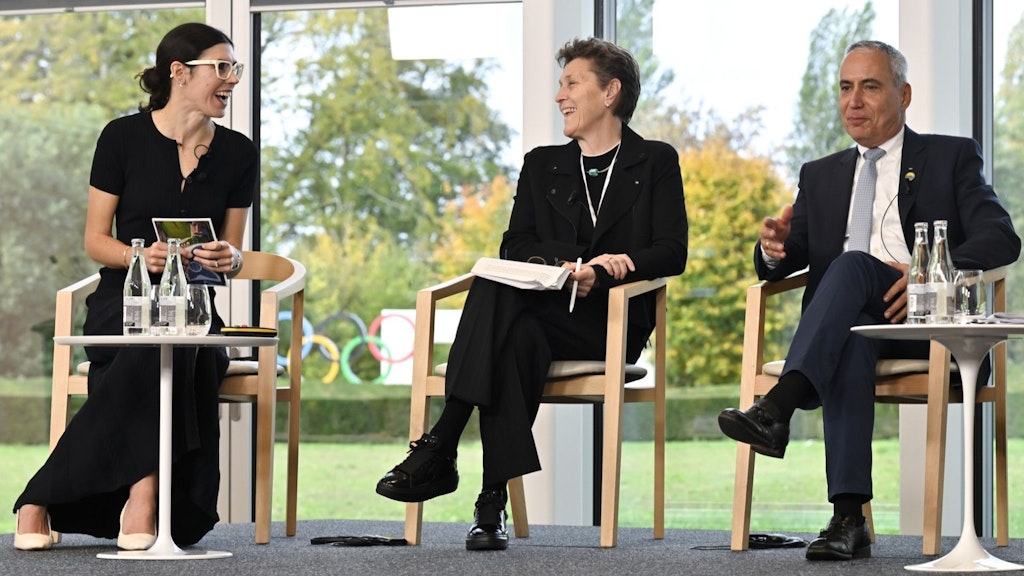
Sandra Felix au Forum international pour le sport et l'intégrité au CIO à Lausanne
Fin octobre, Sandra Felix, directrice de l'OFSPO, a pris la parole lors du Forum international pour l'intégrité dans le sport organisé par le CIO à Lausanne.
Dear Mrs President, dear Mr Deputy Secretary General of the Council of Europe, dear Members of the IOC, dear Ladies and Gentlemen
Switzerland has a long tradition of sport and great love for sport.
- About 75% of the population practice sport on a regular basis. Many belong to one of the almost 20,000 sports clubs.
- Thanks to the presence of the IOC in Switzerland, the country has the privilege of being the chosen seat of many important international Sportfederations and Sportorganisations.
- Switzerland regularly hosts major international sporting events.
These factors give the country a responsibility in terms of good governance in Sport. And Switzerland wants to assume its responsibilities!
After it became known in two thousand and twenty (2020) that there had been cases of maltreatment at the national Performance Centre for Gymnastics, the Swiss Government and the National Olympic Committee «Swiss Olympic» decided to launch a comprehensive project on Ethics in Sport.
The objectives of the project included
- the creation of a legal basis for enforcing ethical principles in Sport,
- the further development of good governance,
- and the establishment of a centralized reporting and disciplinary sanctioning system.
For many years, Swiss sport already has had a so-called Ethic-Charter, that summarises the essential elements of Sport integrity in nine principles. But this charter is not very specific and it is not a legal binding instrument. Therefore, as mentioned above, one of the project's aims was to make the contents of the ethics charter legally binding. This was realized through the design of the funding criteria.
Sports organisations are only eligible for federal funding
- if they comply with regulations on protecting individuals in sport and protecting the competitions,
- if they meet Good Governance requirements, and
- if they accept the competence of the Foundation «Swiss Sport Integrity» to investigate misconduct and the Foundation «Swiss Sports Tribunal» to judge misconduct in Sport
In order to ensure maximum autonomy of Sport and to increase acceptance among Sport Organisations, the regulations to be followed were not laid down by the government itself but by Swiss Olympic. The law only defines the topics, that need to be regulated by Swiss Olympic.
To give you an example: The law stipulates, that Swiss Olympic has to decide on rules regarding term limits. The content of the rules is not determined by law but is the responsibility of Swiss Olympic to define it. Overall, the law requires Swiss Olympic to establish rules on seventeen different topics.
The key topics on good governance are as follows:
- Transparency on organisation, decisions and finances,
- gender equalitiy,
- term limits,
- managing conflicts of interest,
- involvement of athletes,
- data protection,
- ensuring, that the rules to safeguard individuals and to protect competitions are implemented and enforced
Most of these topics are also reflected in the fifty recommendations on good governance issued by IPACS. IPACS's work was therefore a great help in drafting the relevant legal provisions.
From a formal point of view, the rules issued by Swiss Olympic are statutory law and Swiss Olympic is responsible for its control and enforcement. But the content of the rules also constitutes subsidy requirements, and the Federal Office is responsible for ensuring that only organisations that meet these requirements receive federal funds.
I will conclude for now, but not without taking a brief look at the experience with the new system to date.The rules for protecting individuals and competitions are widely accepted and uncontested.
The rules on good governance, particularly regarding issues such as term limits or gender equality, have a harder time. Good governance requirements must be aligned with the diverse structures existing in Sports. Otherwise, they may conflict with the reality of these structures. This is particularly true for smaller clubs and federations that rely heavily on voluntary work and have difficulty finding enough volunteers to take on responsibility.
We have learned that integrity in sport is not primarily a question of rules and laws, but above all a question of culture. And a cultural shift needs time. Sometimes a lot of time.